
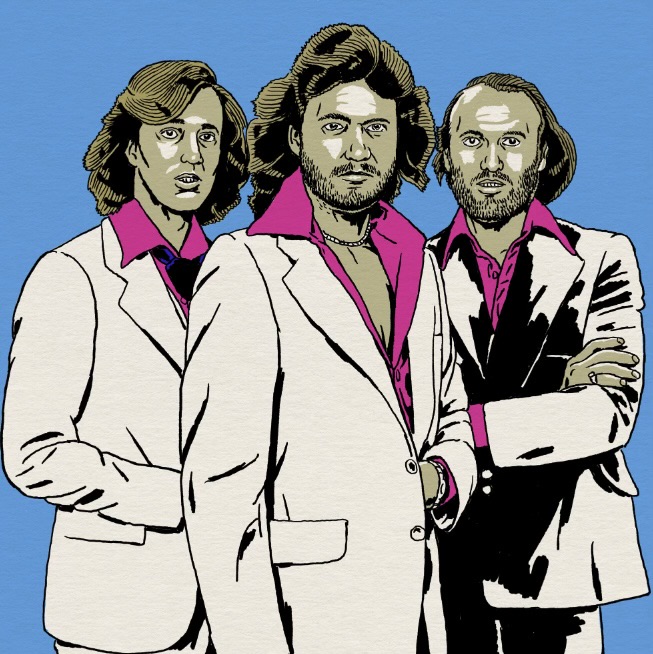
The Bee Gees were a British-Australian pop group formed by brothers Barry, Robin, and Maurice Gibb, widely regarded as one of the most successful and influential songwriting and vocal groups in popular music history. Beginning their career in the late 1950s, the group evolved continuously across decades, adapting to major stylistic shifts while maintaining a distinctive melodic and harmonic identity. Initially gaining fame during the British Invasion era with baroque-pop and ballad-driven songs, the Bee Gees later reinvented themselves in the mid-1970s as central architects of the disco sound. Their work on the Saturday Night Fever soundtrack marked a cultural turning point, defining the sound, image, and global reach of disco music. Characterized by falsetto-led vocals, tight rhythmic grooves, and emotionally direct songwriting, their music dominated international charts and reshaped popular music aesthetics. Beyond their own recordings, the Bee Gees were prolific songwriters for other major artists, contributing to a wide range of hits across genres. Their ability to merge emotional storytelling with technical songwriting precision allowed them to remain relevant across multiple musical eras. With hundreds of millions of records sold worldwide, the Bee Gees’ legacy extends far beyond disco, positioning them as foundational figures in modern pop music and one of the most enduring songwriting teams of the 20th century.